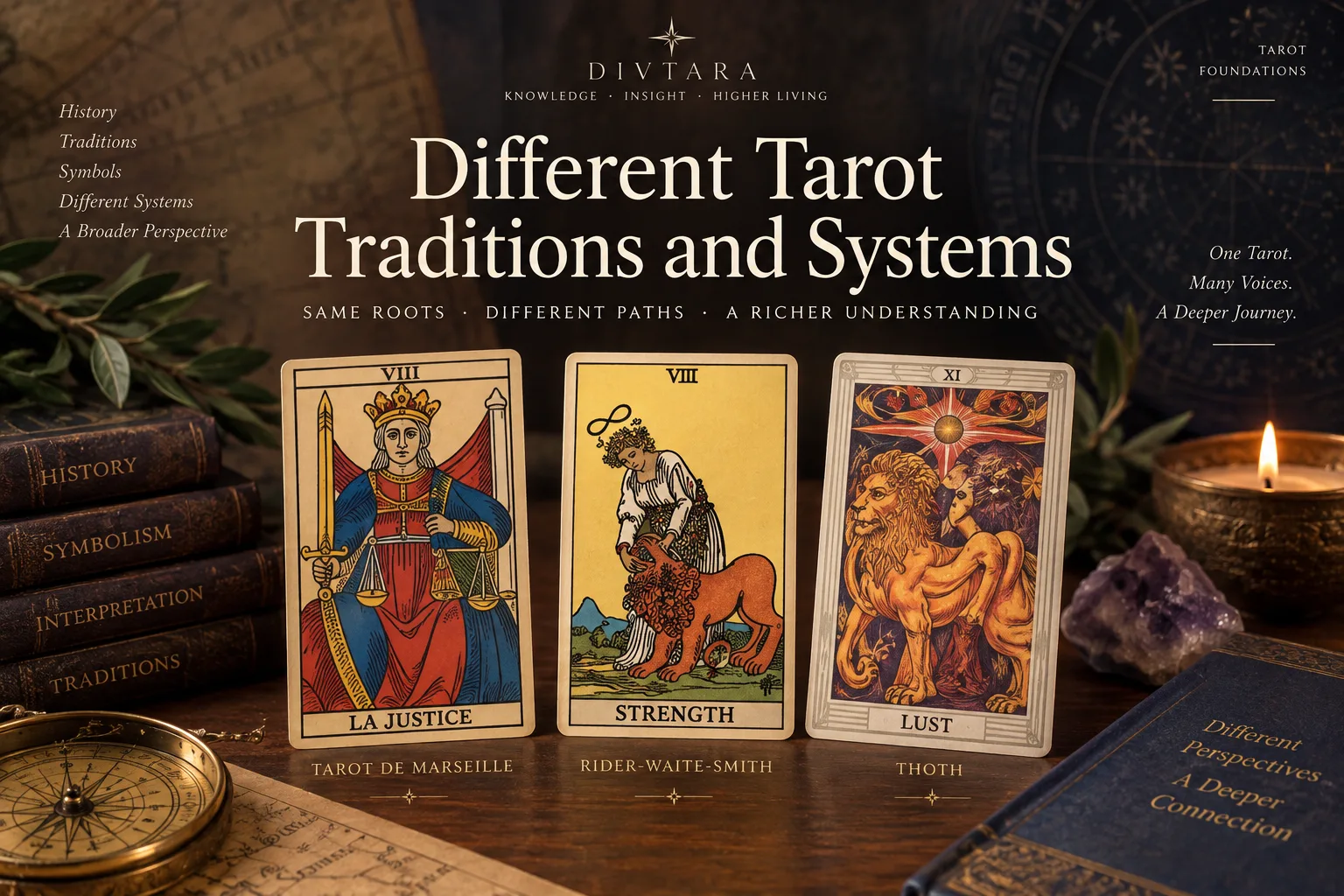
Pick up two Tarot decks and, at first, they may seem to belong to the same family. There are usually seventy-eight cards. You will probably find a Fool, a Magician, a Hermit, a Tower and a World. There will be four suits, numbered cards and court cards. If you already know one Tarot deck, much of the other will feel familiar.
Then you begin looking more closely. Perhaps Justice is card VIII in one deck but XI in another, while Strength has changed places with it. The Page you are familiar with has disappeared and a Princess has taken its place. Pentacles have become Coins or Disks. A numbered card that once showed people acting out an entire scene now contains only an arrangement of swords. Sometimes even the name of a familiar Major Arcana card has changed.
Nothing has necessarily gone wrong. You may simply have moved from one Tarot tradition into another.
Understanding these traditions is one of the points where learning Tarot becomes considerably more interesting. There isn't really a single universal Tarot system sitting unchanged behind every deck. There is a shared ancestry, but different generations of card makers, artists, occultists and readers have developed that inheritance in different directions. Some differences are visual, some structural, and others come from entirely different ideas about how the cards should be interpreted.
What Do We Mean by a Tarot Tradition or System?
The words tradition and system are useful, although their boundaries are not always rigid. A Tarot tradition may preserve a recognizable family of images, card names, numbering and approaches to interpretation. A system may go further by connecting the cards with a particular set of meanings, astrological correspondences, elements, numbers or philosophical ideas. In practice, the two concepts frequently overlap.
It is also important to distinguish a Tarot deck from a Tarot tradition. There are thousands of Tarot decks today, but that does not mean there are thousands of completely independent Tarot systems. A newly published deck might contain original fantasy artwork, unfamiliar characters and a completely different visual atmosphere while still following the structure and much of the symbolism of the Rider-Waite-Smith tradition. Another artist might create a new-looking deck based upon Tarot de Marseille, while someone else may work primarily within the Thoth system.
Some creators borrow from several traditions at once. Others deliberately alter an established system or construct something substantially their own. This means the artwork alone does not always tell us what kind of Tarot we are holding; sometimes we have to look beneath it.
Tarot de Marseille: Older Than the Name Suggests
One of the great historical families of Tarot is known today as the Tarot de Marseille, but the name can easily create the wrong impression. Tarot was not invented in Marseille, nor did the Marseille tradition suddenly appear there as a completely new system. What we now call Tarot de Marseille belongs to a broader development of European Tarot designs.
One of the oldest known surviving decks conforming to the graphical pattern conventionally called Tarot de Marseille was made by Jean Noblet in Paris during the seventeenth century. The Bibliothèque nationale de France explains that the name Tarot de Marseille is used by convention, with Marseille becoming particularly associated with the manufacture of this type of Tarot later, especially during the eighteenth century.
There also isn't one historical object called the Tarot de Marseille from which every later Marseille deck was copied unchanged. Different card makers produced their own versions. Decks associated with Jean Noblet, Jean Dodal, Nicolas Conver and others contain differences, but their shared visual characteristics allow us to recognize a broader Marseille family.
This is worth keeping in mind whenever we talk about Tarot traditions. Historical traditions tend to be messier than the tidy categories we create for them afterwards.
Reading Marseille Is a Different Experience
For someone who learned Tarot with a modern Rider-Waite-Smith-style deck, one of the most obvious differences appears in the Minor Arcana.
Consider the Three of Swords. Many modern readers immediately picture a heart pierced by three swords against a grey and rainy sky. The image is so memorable that heartbreak, sorrow and emotional pain can begin to feel inseparable from the card itself.
That particular image, however, belongs to Pamela Colman Smith's artwork. Look at a traditional Marseille Three of Swords and the pierced heart is absent. Instead, we encounter swords arranged within an ornamental design.
The card has not become meaningless simply because the familiar scene has disappeared; it asks the reader to approach meaning differently. Depending on the particular method being used, a Marseille reader may pay greater attention to the nature of the suit, the significance of the number three, the arrangement and direction of the objects, details within the image and the card's relationship with those around it. There are different schools and methods of reading Marseille as well, so this should not be mistaken for one mandatory formula.
This reveals something useful about Tarot interpretation. What feels like an ancient and inseparable meaning of a card may sometimes owe a great deal to the particular image through which we first learned it. When that image disappears, we begin to notice how much interpretive work it had been doing.
The Rider-Waite-Smith Tradition
For a large proportion of people learning Tarot today, the deck that feels "normal" is itself the product of a particular twentieth-century tradition.
The Rider-Waite-Smith Tarot was created through the collaboration of Arthur Edward Waite and artist Pamela Colman Smith and first appeared in 1909. Both had connections with the Hermetic Order of the Golden Dawn, whose elaborate system of Tarot correspondences formed part of the intellectual environment from which the deck emerged. The V&A dates its first publication to 1909, the date we use throughout the Divtara Library.
We've already explored Smith's importance in The History and Evolution of Tarot, but the scale of her contribution becomes especially apparent when different traditions are placed beside one another. Her illustrated Minor Arcana transformed numbered suit cards into scenes in which people work, fight, celebrate, wait, mourn, travel, give, receive and contemplate. Landscapes, weather, posture and the direction in which characters look can all contribute to an interpretation.
The V&A notes that Waite provided more specific instructions for the Major Arcana while Smith had considerably greater freedom with the Minor Arcana. The visual language that resulted became extraordinarily influential. More than a century later, countless decks use entirely new artwork while preserving scenes and symbolic relationships that can be traced back to Smith's designs.
This influence has become so widespread that it can almost disappear from view. A contemporary deck showing three swords piercing a heart may bear little resemblance stylistically to Smith's original card, yet it is still speaking a visual language inherited from Rider-Waite-Smith.
When Strength and Justice Change Places
Another difference often surprises someone who moves between RWS and an older-style Tarot. In the Marseille tradition, Justice generally occupies VIII and Strength XI. Rider-Waite-Smith places Strength at VIII and Justice at XI. The alteration reflects the esoteric system behind Waite's deck rather than an accidental change in numbering.
This creates a curious experience for a beginner who has memorized Strength as VIII and then opens a Marseille-style deck to discover Justice sitting there instead. Neither deck needs to be treated as mistaken. The discrepancy is evidence that they belong to different historical and interpretive traditions.
Small encounters like this are often where Tarot history stops being an abstract subject. The history is suddenly sitting in your hands.
Why Rider-Waite-Smith Became So Influential
There are practical reasons RWS became such a common starting point. Its illustrated Minor Arcana gives beginners a great deal to work with visually, a vast body of books and teaching material has developed around it, and learning its visual language makes many contemporary decks immediately accessible.
If someone learns the RWS Five of Pentacles and later buys a fantasy deck showing two exhausted travellers struggling through a frozen landscape, they may recognize the relationship even though the artwork is entirely new. Over time, this has created something resembling a visual dialect shared by a very large number of modern Tarot decks.
Its popularity should not, however, be confused with universality. Rider-Waite-Smith is an enormously influential way of organizing, illustrating and interpreting Tarot, but it is not the original form of Tarot from which everything else should be treated as a deviation.
The Thoth Tarot: A Different Branch
Moving from Rider-Waite-Smith to the Thoth Tarot can feel like a more substantial change. The deck was created through the collaboration of Aleister Crowley and Lady Frieda Harris, with Harris producing its remarkable paintings between 1937 and 1943. The Warburg Institute preserves Harris's original paintings along with material connected with their collaboration.
Crowley and Harris inherited some of the same Golden Dawn background that had influenced Waite and Smith, but they developed that inheritance in a very different direction. The Thoth Tarot incorporates astrology, Qabalah, ceremonial magic and Crowley's philosophy of Thelema within a densely interconnected symbolic structure. Harris's paintings frequently communicate through geometry, colour, movement and abstract relationships rather than the more immediately recognizable narrative scenes familiar from RWS.
Some familiar Major Arcana names change as part of this reinterpretation. Justice becomes Adjustment, Strength becomes Lust, Temperance becomes Art, Judgement becomes The Aeon, and the World becomes The Universe. These are not simply decorative attempts to make old cards sound different. They reflect the philosophical and esoteric system Crowley was constructing around the deck.
The court cards also change. Rider-Waite-Smith generally uses Page, Knight, Queen and King, whereas Thoth uses Princess, Prince, Queen and Knight. Pentacles become Disks, and the identities and correspondences of the court figures operate within Crowley's wider system.
Three Major Traditions at a Glance
By this point, the similarities and differences are easier to see together. The table below is intended as a reference rather than a replacement for understanding each tradition in its own context.
Feature | Tarot de Marseille | Rider-Waite-Smith | Thoth |
Historical setting | Marseille-type patterns recognizable by the 17th century, developing from earlier European Tarot | First published 1909 | Paintings created 1937–1943; deck published later |
Minor Arcana | Primarily non-scenic pip cards | Fully illustrated narrative scenes | Symbolic and esoteric compositions |
VIII | Justice | Strength | Adjustment |
XI | Strength / Force | Justice | Lust |
Typical Court Cards | Valet, Cavalier, Queen, King* | Page, Knight, Queen, King | Princess, Prince, Queen, Knight |
Coin suit | Coins / Deniers | Pentacles | Disks |
Reading emphasis | Number, suit, visual structure, traditional imagery and card relationships | Visual storytelling combined with symbolic and esoteric correspondences | Astrology, Qabalah, Thelema and interconnected esoteric symbolism |
Modern influence | Major historical and living Tarot tradition | Foundation for a very large number of contemporary decks | Major influence on esoteric and occult-oriented Tarot |
Names vary according to language, deck and historical edition.
The table also makes something clear that can be harder to notice when each tradition is studied separately: these are not simply three artistic treatments of identical cards. They sometimes organize, name and interpret the Tarot differently.
The Three of Swords Across Three Traditions
We can now return to the Three of Swords and see what happens when a single card travels through these traditions.
In a traditional Marseille deck, we encounter a patterned arrangement of swords rather than a narrative scene. Pamela Colman Smith gives us the famous pierced heart, creating one of the most immediately recognizable images in modern Tarot. In Thoth, the Three of Swords is explicitly titled Sorrow, with Harris presenting it through a dark and turbulent symbolic composition informed by the esoteric correspondences of Crowley's system.
All three retain the number three and belong to the same broad suit ancestry, yet the experience of encountering them is quite different. Marseille can lead the reader towards number, suit, visual form and surrounding cards; RWS offers an immediately recognizable emotional metaphor; Thoth deliberately locates the card inside a network of astrological, Qabalistic and other esoteric relationships.
This is why the question "What does the Three of Swords mean?" sometimes needs a second question before we answer it: which Three of Swords, and within which tradition?
Where Does Etteilla Fit?
The modern prominence of Marseille, Rider-Waite-Smith and Thoth can make Tarot history appear to be a neat progression from one to the next. The actual history contains far more branches.
Etteilla, the professional name of Jean-Baptiste Alliette, developed one of the earliest systematic approaches to Tarot specifically intended for divination during the eighteenth century. He had already worked with cartomancy using ordinary playing cards and went on to develop Tarot meanings and cards shaped specifically around divinatory practice. His work also incorporated the supposed Egyptian origins of Tarot that had become fashionable in eighteenth-century French occult thought.
Etteilla therefore occupies an important position in Tarot's history even though someone entering a bookshop today is far less likely to encounter an Etteilla deck than an RWS-derived one. His work demonstrates that the development of divinatory Tarot did not follow a straight road towards Rider-Waite-Smith. Other systems were being constructed, used and transmitted along the way.
Some branches proved highly influential, some remained within smaller communities, and others gradually faded from widespread use. Their existence matters because it prevents us from mistaking the traditions most visible today for the only traditions Tarot ever possessed.
Not Every Historical Tarot Became a Modern Reading System
There are also historical Tarot forms that are important to understanding the development of the cards without necessarily representing major schools of modern divinatory practice.
Minchiate, associated particularly with Florence and Tuscany, dramatically expanded the familiar Tarot structure. Its larger trump sequence incorporated additional virtues, zodiacal signs, the four elements and other subjects. Elsewhere in Europe, regional packs changed suit signs, trump imagery and other aspects of the cards.
Some Tarot packs continued primarily as games rather than tools for divination. Others reflected particular local artistic traditions, and some forms eventually disappeared from common use. This makes a simple family tree difficult to draw. Tarot's development is better understood as a collection of related branches that sometimes influenced one another, sometimes developed independently for long periods, and did not all survive with equal prominence.
What About Modern Tarot Decks?
Modern Tarot makes these distinctions both more interesting and more complicated.
Imagine buying a Tarot deck based entirely on Indian mythology. The Fool has become a wandering seeker, the Emperor appears through an entirely different cultural and artistic vocabulary, Pentacles have been replaced with another symbolic object, and the landscapes bear no resemblance to anything Pamela Colman Smith painted.
The deck could still be fundamentally based on Rider-Waite-Smith. If its scenes, card relationships and interpretive structure closely follow RWS, changing the cultural clothing does not necessarily change the system underneath.
Another deck might look visually traditional while substantially changing its meanings and correspondences. A creator might also begin with RWS imagery, borrow astrological ideas associated with another occult tradition and then add an entirely new philosophical interpretation. Modern Tarot is full of such hybrid approaches.
This is one reason the guidebook accompanying a deck can be genuinely important. It can tell us whether the creator is working within an established tradition, adapting one, combining several or deliberately creating something new. Knowing that context allows us to understand the deck on its own terms rather than forcing it into whichever system we happened to learn first.
Is One Tarot System More Authentic Than Another?
Once we know some of the history, the question of authenticity becomes more complicated.
Tarot de Marseille preserves visual structures that are closer to older European Tarot traditions than Rider-Waite-Smith or Thoth. That gives it real historical weight, but age alone does not make every later development invalid. Rider-Waite-Smith introduced a form of visual storytelling that profoundly changed how readers could approach the Minor Arcana. Thoth developed an unusually elaborate esoteric framework. Etteilla was instrumental in the development of systematic divinatory Tarot, while modern creators have continued interpreting the cards through new artistic, cultural, spiritual and psychological perspectives.
Rather than asking Which one is the real Tarot?, it is often more useful to ask what a particular system is trying to do, where its ideas came from, and whether we understand the tradition within which those ideas make sense. That gives us a much better basis for judging it than age or popularity alone.
Which Tarot System Should a Beginner Learn?
Rider-Waite-Smith is frequently recommended to beginners, and there are sensible reasons for that. The illustrated Minor Arcana provides plenty of visual information, teaching resources are abundant, and learning RWS makes a large proportion of contemporary decks easier to understand.
That does not mean everyone has to begin there. Someone fascinated by historical Tarot may feel much more at home with Marseille, where learning to work with number, suit, visual structure and card relationships can develop a different kind of reading practice. Someone deeply interested in astrology, Qabalah and Western esotericism might find Thoth compelling from the beginning, although its interconnected symbolic framework gives the learner considerably more background material to explore.
A beginner therefore does not need to worry excessively about choosing the "correct" system. What matters more is knowing what you are holding, learning how that particular tradition approaches the cards and avoiding the assumption that every meaning taken from one deck transfers unchanged into every other one.
Can Tarot Traditions Be Mixed?
In a sense, they already have been. Much of Tarot's later history consists of people inheriting ideas and then combining, reorganizing, expanding or reinterpreting them. There is nothing inherently wrong with a modern reader finding value in Marseille numerology, RWS visual storytelling and astrological correspondences associated with an occult system.
The important distinction is between mixing traditions consciously and mixing them without realizing it. If you know that the pierced heart of the Three of Swords comes from Pamela Colman Smith's imagery, you can decide how much importance to give that image when reading another deck. If you know that a particular astrological correspondence entered Tarot through a later occult tradition, you can use it without needing to imagine that the same correspondence was necessarily attached to the card in fifteenth-century Italy.
Knowing where an idea comes from does not restrict us from using it. Quite often, it gives us greater freedom because we can decide what we want to retain, combine or question rather than inheriting everything unconsciously.
Learning the Language Behind Your Deck
When we first encounter Tarot, it is natural to think of the cards as fixed objects. The Hermit is the Hermit, the Tower is the Tower, the Three of Swords means heartbreak, and Strength is VIII. After enough time with one tradition, its particular choices can begin to feel like properties of Tarot itself.
Then another deck quietly disagrees with us, and that disagreement can be useful. It reminds us that Tarot is not a single book written by one author. It is closer to a language that has travelled through different countries, centuries and schools of thought. The grammar remains recognizable, but accents change. Words acquire new shades of meaning, some expressions disappear, and others become so familiar that we eventually forget they were once innovations.
Tarot de Marseille, Rider-Waite-Smith and Thoth do not need to be treated as competing answers to what Tarot ought to be. They represent different developments within the much longer story of what Tarot has become, while Etteilla, Minchiate, regional packs and numerous later systems remind us that even these three traditions do not tell the whole story.
Learning those differences gives us something more valuable than another collection of seventy-eight definitions to memorize. It allows us to look at a card and begin asking where its imagery came from, why it carries a particular meaning, which ideas belong to its historical structure and which were added later.
Once we begin asking those questions, we are no longer simply learning what a Tarot card is supposed to mean. We are beginning to understand the language behind the deck we are actually holding.