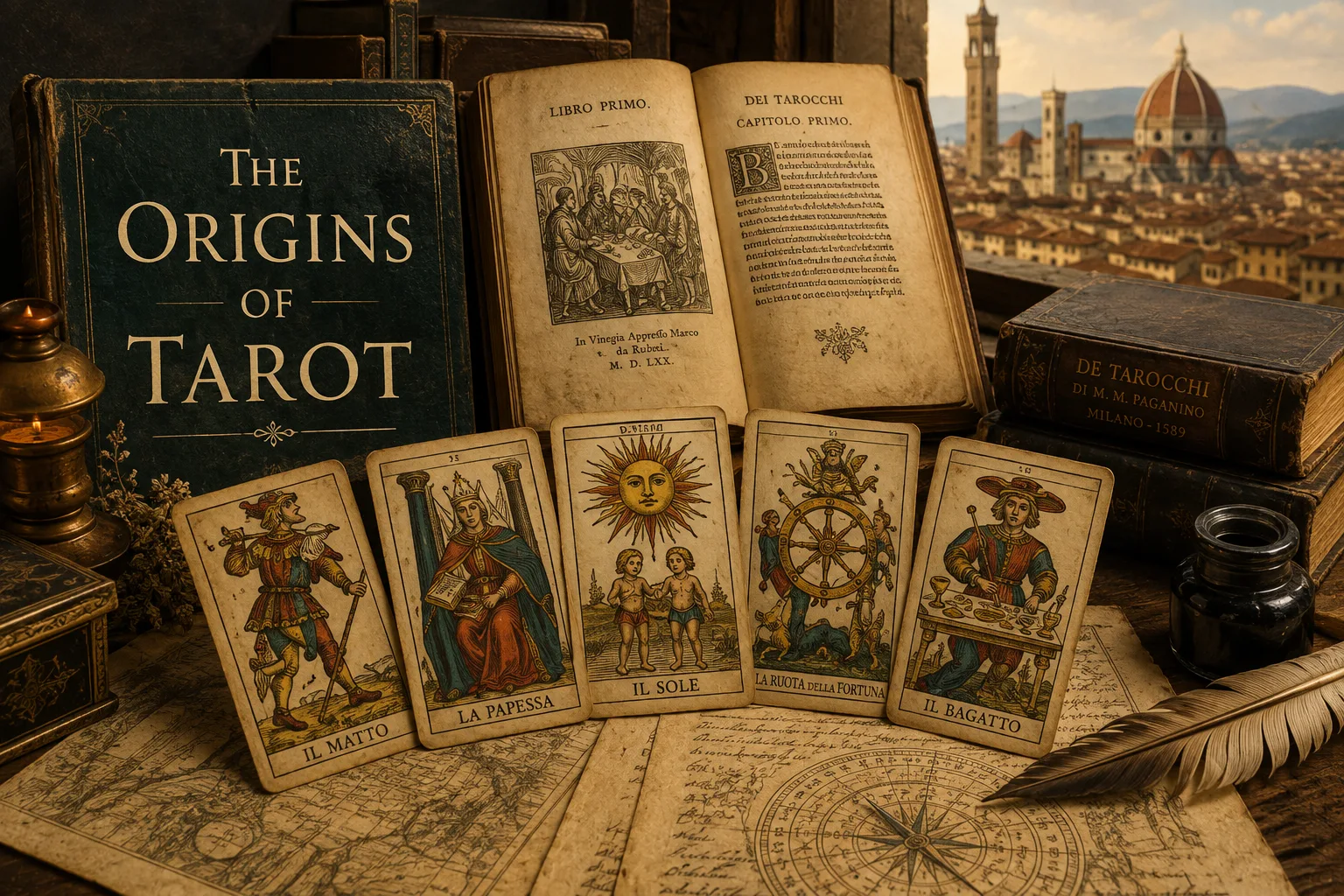
Tarot today is surrounded by stories of ancient temples, secret teachings, mystical orders and knowledge carried across civilizations. These stories have become part of Tarot's cultural identity, but when we ask a more specific question—where did Tarot actually come from?—the surviving historical evidence leads us somewhere quite different.
The story begins not in ancient Egypt or within a forgotten mystery school, but in fifteenth-century Italy, where Tarot emerged from an already established European tradition of playing cards. The earliest known Tarot-like decks appeared among the courts of northern Italy, particularly around Milan, Ferrara and other centres of Renaissance culture.
One thing tends to surprise people encountering Tarot for the first time: the earliest cards weren’t made for fortune-telling. They were made for playing a card game.
Understanding how that game developed requires us to go slightly further back, to the playing cards that existed before Tarot itself.
Before Tarot: The Arrival of Playing Cards in Europe
Playing cards were already circulating in Europe by the late fourteenth century, several decades before the first known Tarot decks appeared.
Their precise journey into Europe is still a subject of historical study, but there is strong evidence connecting European playing cards with earlier card traditions from the Islamic world. Particularly important are surviving cards associated with the Mamluk Sultanate, which ruled Egypt and surrounding territories during the medieval period.
Mamluk playing cards used suits including cups, coins, swords and polo sticks. As playing cards developed within southern Europe, particularly Italy and Spain, remarkably similar suit systems appeared: Cups, Coins, Swords and Batons.
The resemblance does not mean that Tarot itself came from ancient Egypt. That is an important distinction. Rather, the ordinary playing-card tradition from which Tarot eventually developed appears to have been influenced by cards that reached Europe through contact with the Islamic world.
European card makers adapted these traditions to their own cultures. Court figures changed, artistic styles developed and regional variations emerged. By the early fifteenth century, playing cards had become established enough in Italy that something new could be built upon them.
That something would eventually become Tarot.
From Playing Cards to Trionfi
During the fifteenth century, Italian card makers began adding a special sequence of illustrated cards to the familiar four-suited deck.
Early sources referred to these cards and the game played with them as trionfi, or "triumphs." These additional cards functioned as trumps, capable of outranking cards from the ordinary suits during play.
The innovation was significant. Instead of containing only numbered cards and court figures, the expanded decks now included elaborate allegorical images representing recognizable figures, forces and ideas.
Among them were rulers and religious authorities, virtues such as Justice and Temperance, images of Fortune and Death, and celestial subjects such as the Moon, Sun and Stars. Alongside these appeared the Fool, a distinctive figure who occupied an unusual place within the game.
The exact names, ordering and number of the trump cards were not immediately identical everywhere. Different regions and individual decks showed variations before the structure became increasingly standardized.
Nevertheless, the essential idea had appeared: four ordinary suits accompanied by a separate sequence of illustrated trump cards.
That structure became the foundation of Tarot.
Why "Triumphs"?
The term trionfi belonged naturally to Renaissance Italian culture.
Triumphal processions had long been associated with victory, power and public spectacle, drawing partly upon memories of the triumphs of ancient Rome. Renaissance literature and art also used processions of allegorical figures to represent the succession of human conditions, virtues, powers and forces.
One particularly famous example from the period is Petrarch's I Trionfi (The Triumphs), a poetic sequence in which allegorical forces such as Love, Chastity, Death, Fame, Time and Eternity triumph over one another.
It is tempting to assume that Petrarch's poem directly produced the Tarot trump sequence, but the historical relationship is not simple enough to state that as fact. What it does demonstrate is that allegorical triumphs were already part of the cultural language of the period.
The idea of one symbolic force succeeding or overcoming another would therefore not have seemed nearly as strange to a fifteenth-century Italian audience as it might to us today.
The Tarot of the Renaissance Courts
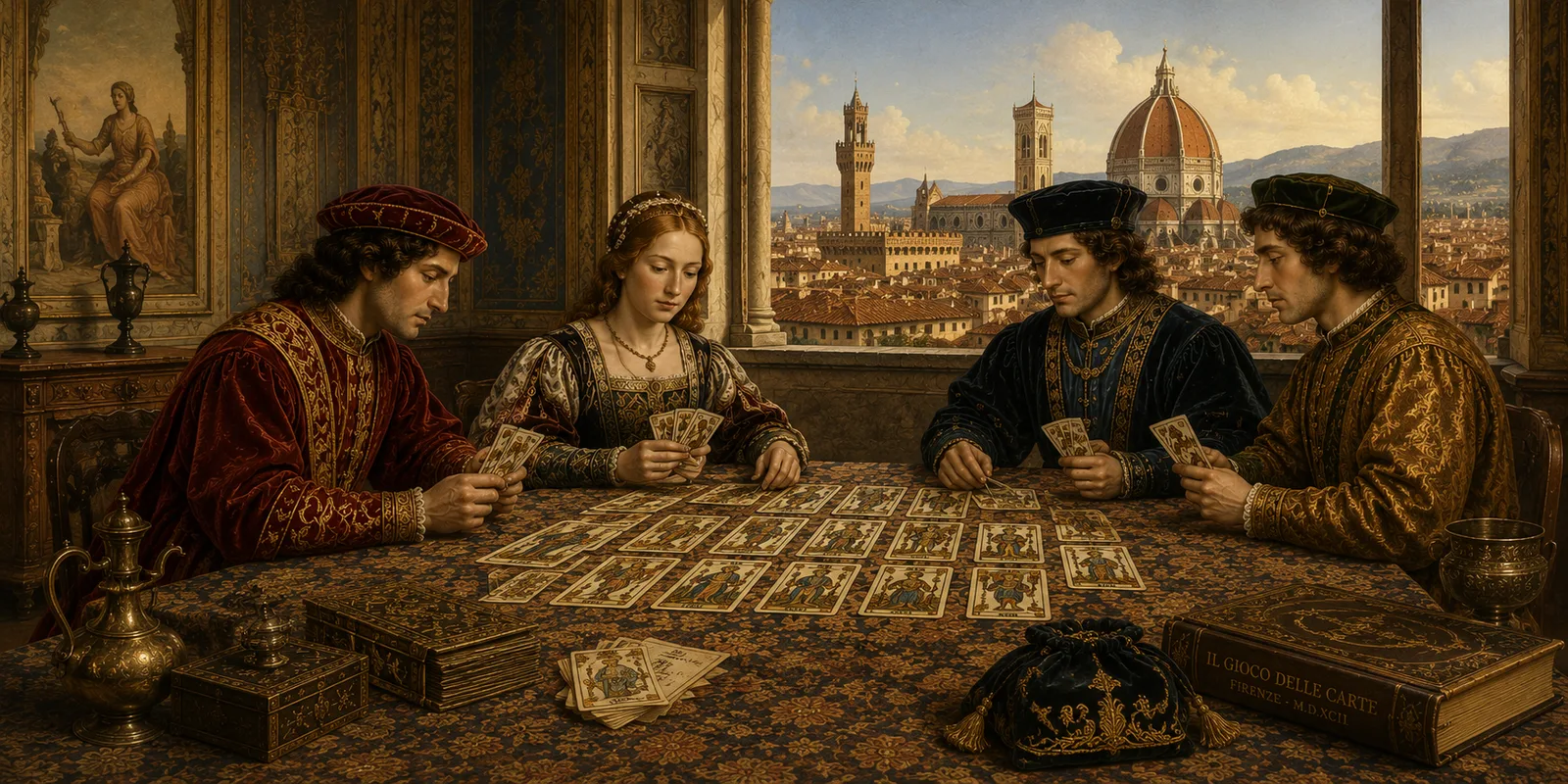
Some of the oldest surviving Tarot cards come from the wealthy courts of northern Italy.
Among the most famous are the magnificent cards associated with the Visconti and Sforza families of Milan. Rather than inexpensive playing cards, these surviving examples were luxury objects, carefully painted and embellished with rich pigments and gold.
Commissioning such a deck could therefore be an expression of wealth, status and artistic patronage as much as entertainment.
This also helps explain why some of our best evidence for early Tarot comes from aristocratic environments. Hand-painted cards made for powerful families had a better chance of being valued and preserved than inexpensive cards subjected to years of ordinary play.
The surviving Visconti-Sforza cards give us an extraordinary glimpse into Tarot before it became associated with modern occultism. Many figures are already immediately recognizable as ancestors of cards found in later decks, even though their names, ordering and visual details were not always identical to those familiar to modern readers.
Tarot's basic visual vocabulary was beginning to take shape.
Understanding the Images Through Their Own Time
Looking at early Tarot cards through modern eyes can easily make them seem deliberately mysterious.
A skeletal Death, a turning Wheel of Fortune, an Emperor, a Pope, personified virtues and images of the heavens can appear like fragments of an encoded mystical system. Yet much of this imagery belonged naturally to the visual and intellectual world of medieval and Renaissance Europe.
Justice, Strength and Temperance, for example, were established virtues represented throughout European art.
The Wheel of Fortune was already a widespread symbol of the instability of worldly success—the powerful could rise, reign and fall as Fortune's wheel turned.
Death appeared frequently in medieval religious and artistic imagery, particularly within a culture deeply conscious of mortality.
The Emperor and Pope represented recognizable forms of temporal and spiritual authority.
The Sun, Moon and Stars belonged naturally to both religious imagery and contemporary understandings of the cosmos.
This does not mean that the cards were devoid of symbolic meaning simply because they were used in a game. Renaissance culture was filled with allegory, and entertainment could comfortably coexist with moral, religious, political and philosophical imagery.
What we should avoid is assuming that the people who created these cards necessarily understood every image through the later occult systems that would eventually become associated with Tarot.
Those systems had not yet been developed.
Was Early Tarot Already a Spiritual or Occult System?
There is currently no convincing historical evidence that the first Tarot decks were created as a secret spiritual textbook, an initiatory system or a method of divination.
The surviving evidence places them primarily within the world of playing cards, courtly entertainment and Renaissance artistic culture.
This distinction is important because later generations would eventually connect Tarot with Hermeticism, astrology, Kabbalah, ceremonial magic and numerous other esoteric traditions. Looking backward through those later developments can create the impression that all of these systems must have been hidden inside Tarot from the beginning.
History does not support that conclusion.
At the same time, saying that Tarot began as a card game does not mean its imagery was meaningless. A game can carry art, symbolism, social values and cultural ideas without secretly being an occult manual.
In many ways, that makes Tarot's later development even more interesting. The images were sufficiently rich and adaptable that people living centuries later could reinterpret them through entirely different philosophical systems.
When Did Trionfi Become Tarot?
The earliest cards were not originally called "Tarot."
The term trionfi was used during the fifteenth century, while the Italian word tarocchi appeared later. From this developed related names elsewhere in Europe, including the French tarot, which eventually gave English the name commonly used today.
As the game spread and printing made playing cards easier to reproduce, regional forms developed. The expensive hand-painted decks associated with Renaissance courts gradually existed alongside much cheaper printed cards accessible to a wider population.
The Tarot was beginning to move beyond the aristocratic world in which some of its earliest surviving examples had been created.
Yet for a considerable period it remained primarily what it had originally been – a card game whose transformation into something else would take centuries.
The Egyptian Origin of Tarot
One of the most enduring stories about Tarot is that it originated in ancient Egypt.
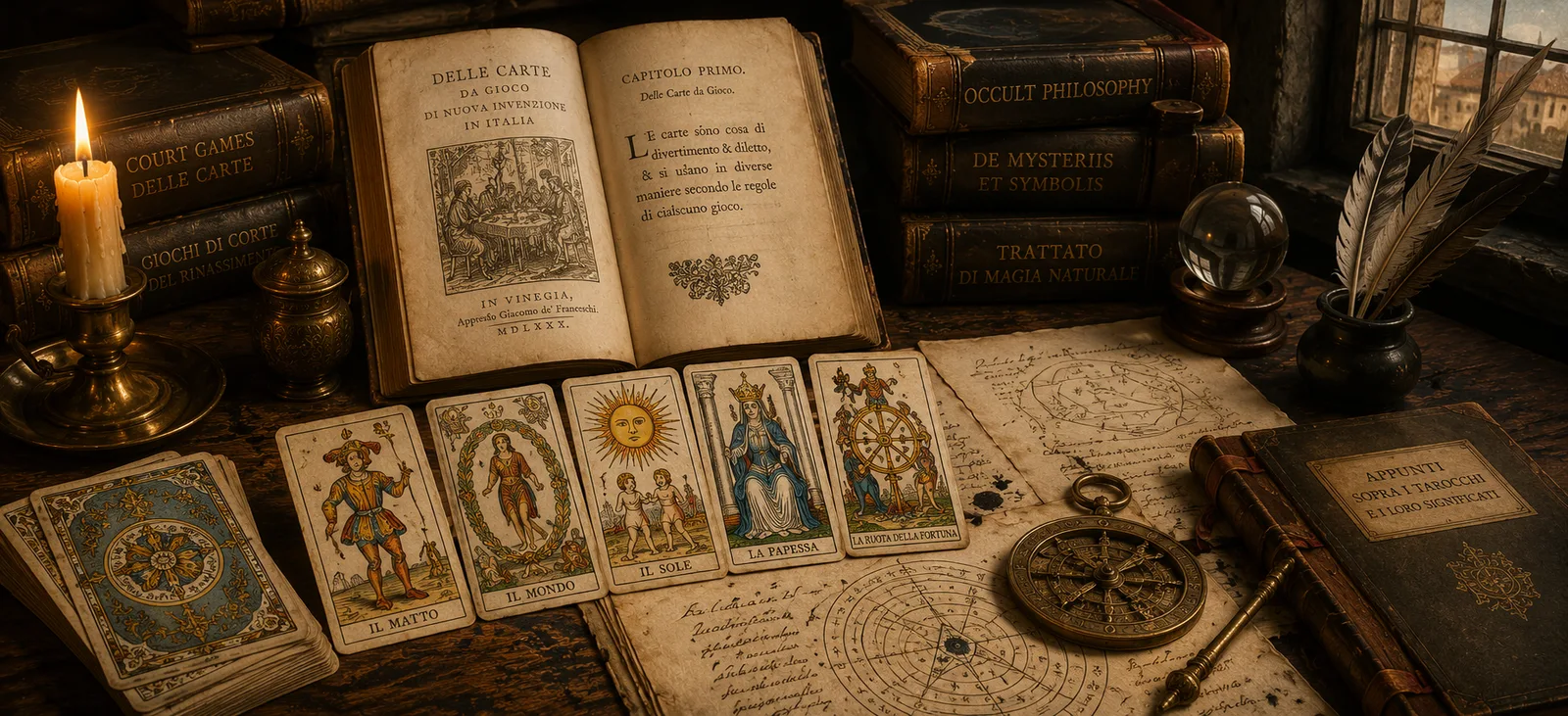
This idea did not accompany the earliest known Tarot cards. It appeared much later, particularly in eighteenth-century France.
A major figure in popularizing the theory was Antoine Court de Gébelin, who argued that Tarot preserved ancient Egyptian wisdom hidden within the form of an ordinary card game. His interpretation appeared in Le Monde Primitif during the 1780s and profoundly influenced later occult approaches to Tarot.
Another influential figure, Jean-Baptiste Alliette, better known as Etteilla, developed Tarot further as a system specifically intended for divination and incorporated Egyptian and astrological ideas into his work.
The Egyptian theory was enormously influential. Later occultists expanded upon it, and Tarot gradually became connected with Hermeticism, Kabbalah, astrology and other esoteric traditions.
But influence and historical origin are two different questions.
There is no established evidence of Tarot decks existing in ancient Egypt, nor evidence demonstrating an unbroken Egyptian Tarot tradition leading to fifteenth-century Italy. The Egyptian-origin theory therefore belongs to the history of Tarot's occult interpretation, rather than to the documented history of Tarot's creation.
That does not make the theory irrelevant. Ideas do not need to be historically accurate descriptions of an origin to exert enormous influence over what something later becomes.
In Tarot's case, the Egyptian theory helped change the course of its history.
Myth and History
Tarot presents us with an interesting problem because its historical origin and its later identity are so different.
If we say that Tarot is an ancient Egyptian book of secret wisdom, we move beyond what the historical evidence supports.
But describing Tarot as "nothing more than a card game" creates a different distortion. It tells us where Tarot began while ignoring several centuries of genuine cultural development that transformed what the cards meant to people.
The more useful distinction is between origin and evolution.
Tarot appears to have originated as a European card game. Over subsequent centuries, people interpreted and reinterpreted its imagery through new intellectual, spiritual and cultural frameworks. Divination became associated with the cards. Occult correspondences were constructed. Astrological and Kabbalistic systems were developed around them. Artists redesigned their imagery, and later thinkers approached the cards through psychological and archetypal perspectives.
Those later developments did not have to exist in fifteenth-century Italy in order to become authentic parts of Tarot's subsequent history.
Understanding when different ideas entered the tradition helps us appreciate Tarot more clearly rather than diminishing its mystery.
Where, Then, Did Tarot Come From?
Based on the surviving historical evidence, Tarot emerged in fifteenth-century Italy, developing from an existing European playing-card tradition by adding a sequence of illustrated trump cards to four ordinary suits.
Its early cards reflected the artistic, religious, social and allegorical culture of medieval and Renaissance Europe. Some of the finest surviving examples were commissioned by wealthy Italian families and used for a game originally known as trionfi.
There is no convincing evidence that those first decks were designed for fortune-telling or as repositories of an ancient secret doctrine. Those interpretations developed later.
And that distinction gives us something far more interesting than a simple origin story.
Tarot did not emerge fully formed as the system we know today. It became Tarot gradually.
None of that happened all at once, and none of it happened because the original deck was secretly waiting to be decoded. It happened because generation after generation of readers, artists and mystics kept finding something in the cards worth adding to.
The origin of Tarot therefore explains only the beginning.
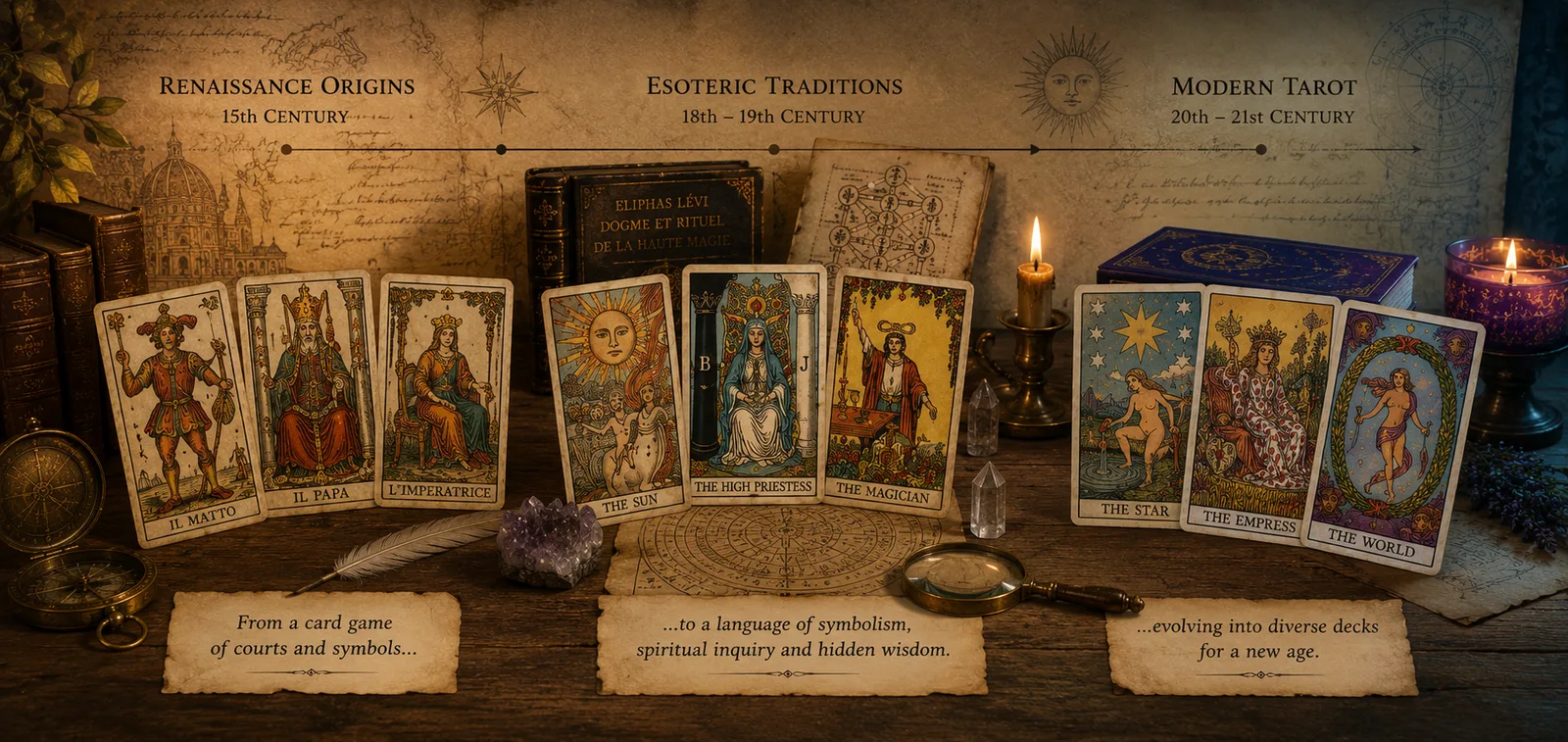
To understand how a Renaissance card game eventually became a tool for divination, occult study, psychological reflection and personal guidance, we have to follow what happened to those cards over the centuries that followed.
That is the next part of the story: The History and Evolution of Tarot.