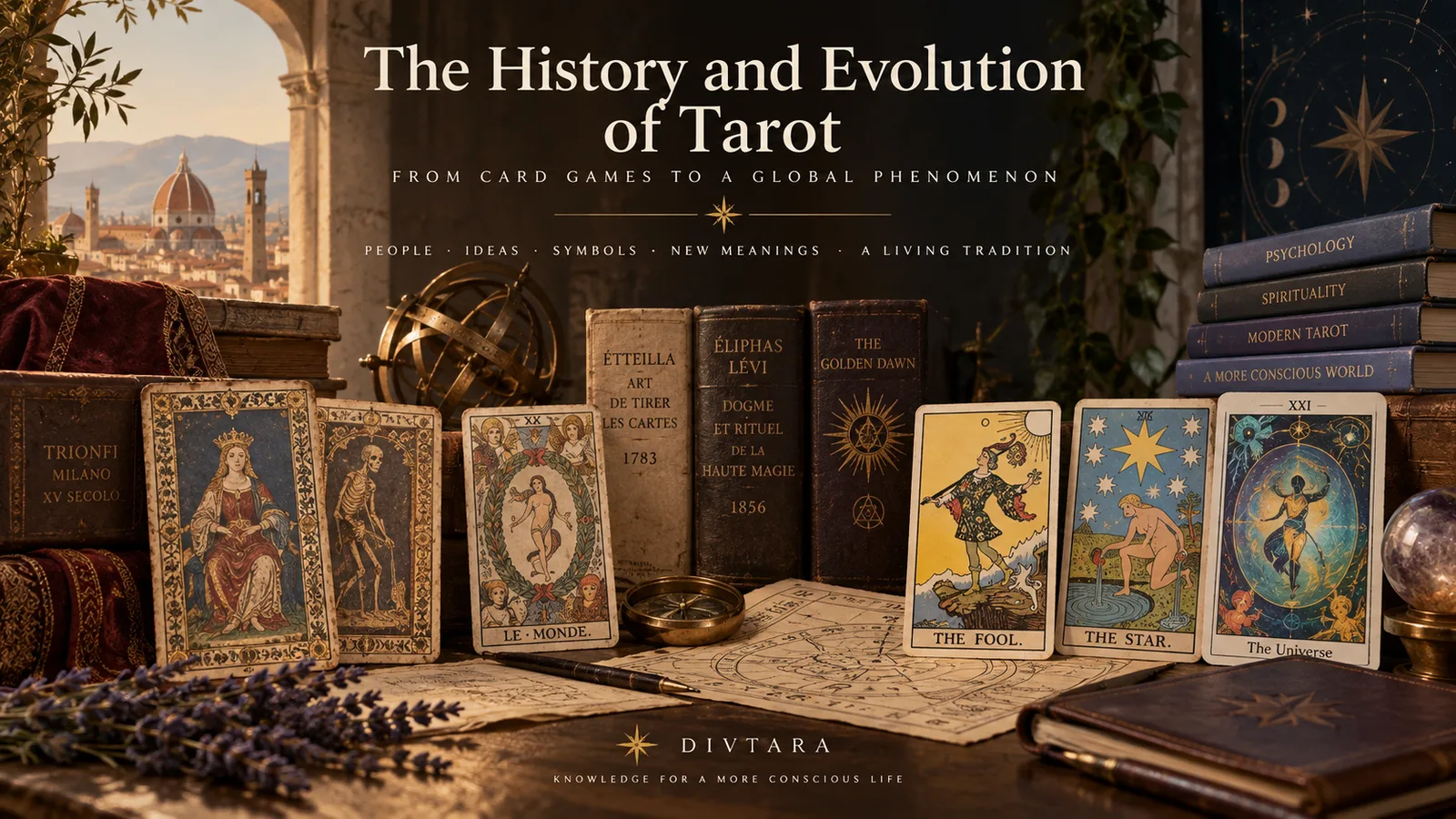
If someone from fifteenth-century Italy were handed a modern Tarot deck and shown how people use it today, they would probably find the whole thing rather strange.
The cards they knew belonged primarily to a game. There were no guidebooks explaining upright and reversed meanings, no established connection between every card and an astrological sign, and certainly no phone apps offering a daily Tarot reading. Much of what we now think of as Tarot came later, sometimes centuries later.
That is what makes its history so interesting. Tarot was never invented once and then handed down unchanged. Different generations kept finding new things to do with it. Card players changed it, printers reproduced it, fortune-tellers developed ways of reading it, occultists connected it with other systems of thought, and artists repeatedly redesigned its imagery.
The result is the Tarot we have today: recognizably descended from those early Italian cards, but carrying layers of ideas that their original makers could never have anticipated.
From the Italian Courts to the Card Table
As we explored in The Origins of Tarot, the earliest documented Tarot decks appeared in fifteenth-century Italy. They combined the existing four suits of Italian playing cards with a separate sequence of illustrated trump cards and a Fool.
Some of the oldest cards that survive today are beautiful hand-painted pieces associated with wealthy families such as the Visconti and Sforza of Milan. They can give the impression that Tarot began as something exclusively aristocratic, but there is a practical reason so many surviving early examples come from wealthy households: expensive objects tend to be preserved.
Ordinary playing cards were handled, shuffled, damaged, lost and eventually thrown away.
As printing techniques improved, cards became easier and cheaper to reproduce. Tarot moved beyond the handful of courts responsible for some of its most famous surviving examples and became part of a much broader European card-playing culture.
Different regions adapted the game in their own ways. Designs changed, rules changed and occasionally the deck itself changed. The Florentine game known as Minchiate, for example, used an expanded set of trumps that included the zodiac signs, the four elements and additional virtues.
Tarot also travelled beyond Italy into France, Switzerland and parts of Central Europe, developing regional traditions along the way. What we now call the Tarot de Marseille grew out of this wider European card-making tradition and would eventually become one of the major reference points in Tarot history.
For quite some time, though, these were still cards people actually sat down and played with.
When Tarot Was Still Mostly a Game
This part of Tarot's history is easy to overlook because we already know what comes later.
We see the Moon, Death, the Devil or the Wheel of Fortune and instinctively approach them as cards filled with divinatory meaning. Someone playing Tarot several centuries ago did not necessarily encounter them that way. A powerful image could carry religious, moral or allegorical associations while still functioning perfectly well as a card in a game.
Tarot games survived for centuries and, in some parts of Europe, are still played today.
Card-based fortune-telling was developing too, but the two traditions should not be treated as though they had always been the same thing. Cartomancy, or divination using cards, often relied on ordinary playing cards. A reader did not need the Fool, the Magician or the Tower to answer questions about marriage, money, travel, relationships or good fortune.
Eventually these two histories would meet.
When they did, Tarot would change dramatically.
A New Way of Looking at the Cards
By the eighteenth century, Europe had changed enormously since the first Italian trionfi decks appeared. Interest in antiquity, secret knowledge, symbolism and esoteric philosophy existed alongside the intellectual currents of the Enlightenment.
It was in this environment that Antoine Court de Gébelin encountered Tarot and proposed a very different explanation for what the cards were.
In 1781, writing in Le Monde Primitif, Court de Gébelin argued that Tarot preserved ancient Egyptian wisdom. What appeared to be an ordinary card game was, in his view, something far older: a symbolic remnant of hidden knowledge that had survived through the centuries.
We have already dealt with this claim in The Origins of Tarot. There is no established historical evidence connecting the creation of Tarot to ancient Egypt.
What matters here is what happened because people believed the idea.
Once Tarot was presented as an ancient symbolic book disguised as playing cards, the pictures invited an entirely different kind of attention. The question was no longer simply how the game worked. People could begin asking what the images concealed.
And once you start looking at Tarot that way, it is very difficult to see it as an ordinary pack of cards again.
Etteilla Turns Tarot Towards Divination
One of the people who took this new understanding much further was Jean-Baptiste Alliette, better known as Etteilla.
Etteilla had already written about fortune-telling with ordinary playing cards. He therefore approached Tarot from a rather different direction from Court de Gébelin. Where Court de Gébelin was interested in what he believed Tarot was, Etteilla was also interested in what someone could actually do with it.
He developed systems of card interpretation, methods of laying out the cards and eventually a deck specifically intended for divination. His system incorporated astrology and Egyptian ideas alongside cartomantic meanings.
This is one of the points where the Tarot familiar to a modern reader begins to come into view.
A deck originally designed around a game was now being deliberately adapted for reading questions, circumstances and possible future events. Meanings could be taught. Cards could be arranged into structured readings. A person could learn a method and practise it.
It was no longer simply a case of finding hidden significance in old pictures. Tarot was developing a new practical life.
The Nineteenth Century and the Occult Tarot
The nineteenth century took Tarot somewhere else again.
French occultists began placing the cards within much larger philosophical systems, connecting Tarot with subjects such as magic, Kabbalah, astrology and numerology. Éliphas Lévi, born Alphonse Louis Constant, became particularly influential in this development.
For Lévi and those who followed him, Tarot could be approached as more than a method of fortune-telling. The cards could form part of a symbolic map linking different branches of esoteric thought.
This is also where we encounter terminology that now feels ancient simply because Tarot readers have heard it for so long.
Major Arcana and Minor Arcana were not the names used by the Italians who created the earliest decks. The language belongs to Tarot's later occult history. Arcana carries the sense of mysteries or secrets, which tells us quite a lot about how differently these writers had come to see the cards.
Connections multiplied from there.
Cards were associated with planets and zodiacal signs. Numbers acquired additional significance. Hebrew letters and Kabbalistic concepts were brought into Tarot interpretation. Elements were assigned systematically, and different correspondences began fitting together into increasingly elaborate structures.
It is tempting to imagine that occultists were slowly uncovering a single ancient code hidden in Tarot all along. Historically, that is difficult to support.
A better way of understanding it is that they were building relationships between symbolic systems.
Those relationships became traditions in their own right.
The Golden Dawn Brings the Systems Together
By the late nineteenth century, Western occultism contained an extraordinary collection of ideas drawn from ceremonial magic, astrology, Kabbalah, alchemy, Hermetic philosophy and other traditions.
The Hermetic Order of the Golden Dawn, founded in Britain in 1888, attempted to bring many of these strands into an organized system.
Tarot fitted remarkably well into that project.
Individual cards could be related to Hebrew letters, elements, planets, zodiacal signs and positions within a larger Kabbalistic structure. Rather than studying each symbolic tradition separately, a Golden Dawn initiate could encounter them as parts of an interconnected whole.
Some of these correspondences came from earlier occultists; others were reorganized or developed further within the Order. The result had an enormous influence on twentieth-century Tarot.
And from this environment came several people who would reshape Tarot yet again.
Two of them were Arthur Edward Waite and Pamela Colman Smith.
Pamela Colman Smith Changes the Way the Cards Speak
In 1909, a deck illustrated by Pamela Colman Smith, created under the direction of Arthur Edward Waite and published by Rider, introduced a visual approach that would eventually become so familiar that it is easy to forget how significant it was.
Today we generally call it the Rider-Waite-Smith Tarot, giving Smith the recognition that older references to the "Rider-Waite" deck often left out.
The Major Arcana had long been filled with elaborate figures and scenes. Many earlier numbered cards in the four suits, however, were considerably simpler. A card might show five coins, six swords or eight cups arranged decoratively, leaving much of the interpretation to established meanings and numerical or elemental associations.
Smith did something different with the Minor Arcana.
She gave the cards scenes.
A person encountering the Five of Pentacles does not simply see five symbols belonging to the suit. There are figures outside in the cold. The Ten of Swords does not merely present ten blades; it shows the aftermath of something devastating. The Six of Cups contains people interacting within a scene that can immediately suggest memory, exchange or childhood.
Even before learning a formal meaning, there is something to respond to.
That changed the relationship between reader and card.
Instead of asking only, What does the Five of Pentacles mean?, the reader could also ask, What is happening here? Who are these people? What might they be feeling? What details am I noticing, and why?
This visual storytelling became one of the foundations of modern intuitive Tarot reading.
Smith was working within a particular esoteric environment, of course, and Waite provided direction for the deck, particularly for the Major Arcana. But her contribution should not be reduced to simply illustrating someone else's system. The visual language she created for the Minor Arcana has influenced generations of Tarot artists who came after her.
Look through a selection of modern decks today and her fingerprints are everywhere.
Another Path: Crowley and Harris
Not everyone coming from the Golden Dawn tradition took Tarot in the same direction.
Aleister Crowley and Lady Frieda Harris produced something else entirely.
Harris painted the images that became the Thoth Tarot between 1937 and 1943, working closely with Crowley on an elaborate system drawing upon astrology, Kabbalah, ceremonial magic and Crowley's own philosophy of Thelema.
Where Pamela Colman Smith often gives us recognizable human scenes, Harris frequently gives us something more abstract. Colour, geometry, movement and layered symbols carry much of the meaning.
The difference is immediately apparent when the decks are placed beside one another.
Both grew partly from the same broad occult heritage, yet they do not feel like two versions of the same artistic idea. They demonstrate how much room Tarot had acquired for interpretation.
By this point there was no longer one obvious path along which the cards had to develop.
There were branches.
Tarot Moves Out into the Wider World
For much of its occult history, serious study of Tarot could involve specialized books, esoteric societies or fairly small circles of practitioners.
The twentieth century gradually changed that.
Commercial publishing made decks and books available to increasingly large audiences. A person no longer needed access to an occult lodge to begin studying Tarot. They could buy a deck, find a book and start exploring the cards at home.
That wider audience brought different interests with it.
Some readers remained focused on prediction and fortune-telling. Others were drawn towards ceremonial magic or spiritual practice. Some were fascinated by symbolism and mythology without wanting to practise magic at all.
Another group began looking at the cards as a way of exploring the inner life.
That’s where psychology entered the conversation.
Jung, Archetypes and a Psychological Tarot
The name Carl Gustav Jung appears frequently in modern writing about Tarot, sometimes with claims that go considerably further than the historical evidence allows.
Jung's work dealt extensively with symbols, myths, archetypes and the unconscious, so it is easy to see why later Tarot writers found his ideas attractive. What we should be careful about is turning that connection into the claim that Jung developed a system of Tarot reading or routinely used Tarot as part of his clinical work.
The more interesting story is what Tarot practitioners did with Jung's ideas.
The concept of archetypes offered a different way of approaching familiar cards. The Hermit did not have to be treated only as a prediction of isolation. He could become an image through which someone considered solitude, withdrawal or the search for wisdom.
The Tower could suggest more than an external disaster. It might prompt someone to think about a belief, identity or structure in their life that is collapsing.
The Fool could speak about beginnings, innocence and risk without needing to predict a specific event.
In this kind of reading, the card is not necessarily telling you what will happen next. It gives you an image through which you can look at something that is already happening within or around you.
That approach helped Tarot find an audience among people who might never have considered themselves fortune-tellers or occultists.
When Artists Took Possession of Tarot
Once Tarot reached a broader audience, artists began doing what artists inevitably do with a powerful visual language: they made it their own.
The number and variety of Tarot decks exploded during the later twentieth century and into the twenty-first.
Mythologies entered the cards. So did folklore, fantasy, nature, animals, different spiritual traditions and entirely new artistic worlds. Some creators remained very close to Rider-Waite-Smith imagery, while others worked from Tarot de Marseille, Thoth or less familiar traditions.
Some barely resembled their predecessors at all.
And yet you could often still recognize the skeleton underneath: the Major and Minor Arcana, four suits, court cards and a sequence of familiar archetypal figures.
This freedom created something wonderful, but it also introduced a complication for anyone learning Tarot.
The same card does not always speak exactly the same language in every deck.
A deck based closely on Rider-Waite-Smith may invite one approach. A Marseille deck may require more attention to number, suit and traditional structure because its numbered cards do not provide the same narrative scenes. A Thoth deck brings its own correspondences and terminology.
That is why understanding Tarot traditions matters. We will explore those differences properly in Different Tarot Traditions and Systems rather than trying to squeeze them all into this history.
Tarot Finds the Internet
The internet removed another barrier.
Someone curious about Tarot no longer needed to locate a specialist bookshop, teacher or local community. Decks could be discovered online, interpretations compared in seconds, and readers from completely different countries could discuss the same card together.
Then came social media, video platforms and mobile apps.
A practice that had travelled through hand-painted cards, printed decks and occult manuscripts was suddenly happening on screens.
That transition has not been entirely comfortable. Some readers dislike digital decks. Others question whether a card selected by software can have the same significance as one physically shuffled and drawn. Online readings have also created their own problems, including overly generalized interpretations and content designed more for attention than understanding.
At the same time, digital access has allowed people to study traditions, compare decks, keep journals and encounter historical material that would once have been difficult to find.
Artificial intelligence is now becoming another part of that change. It can help explain unfamiliar symbolism, compare interpretations or organize a person's reflections across readings. Like every earlier tool, though, it can also produce shallow results when used without understanding.
Knowing that The Tower means sudden change is not the same as understanding the Tower.
That distinction existed long before computers arrived.
So What Is Tarot Now?
After following Tarot through several centuries, trying to give it a single definition becomes surprisingly difficult.
It is still a card game in places where traditional Tarot games survive.
It is a method of divination for millions of readers.
For some practitioners it belongs within ceremonial magic or Western esotericism. For others it is primarily spiritual. Some approach it psychologically, some intuitively and some simply love the cards as works of symbolic art.
None of these uses appeared at exactly the same time.
They accumulated as Tarot travelled.
A fifteenth-century Italian card maker did not design the Major Arcana around Jungian psychology. Pamela Colman Smith did not create her Minor Arcana illustrations for a smartphone screen. Etteilla could not have imagined thousands of people discussing a card together across social media.
Each generation inherited something and added something.
That is probably the most useful thing to remember when learning Tarot today, because it changes the question we ask when somebody tells us that a particular card "means" something.
Instead of stopping at the meaning, we can ask:
Where did that meaning come from?
Sometimes it comes naturally from the image itself. Sometimes it belongs to an old cartomantic tradition. It may come from astrology, Kabbalah or another occult correspondence. It may have been strengthened by imagery Pamela Colman Smith introduced. Or it may belong mainly to the creator of one particular modern deck.
Once we start noticing those layers, Tarot becomes much more interesting than a list of seventy-eight definitions to memorize.
It becomes a language with a history.
And like any living language, it has changed every time people found a new way to speak with it.