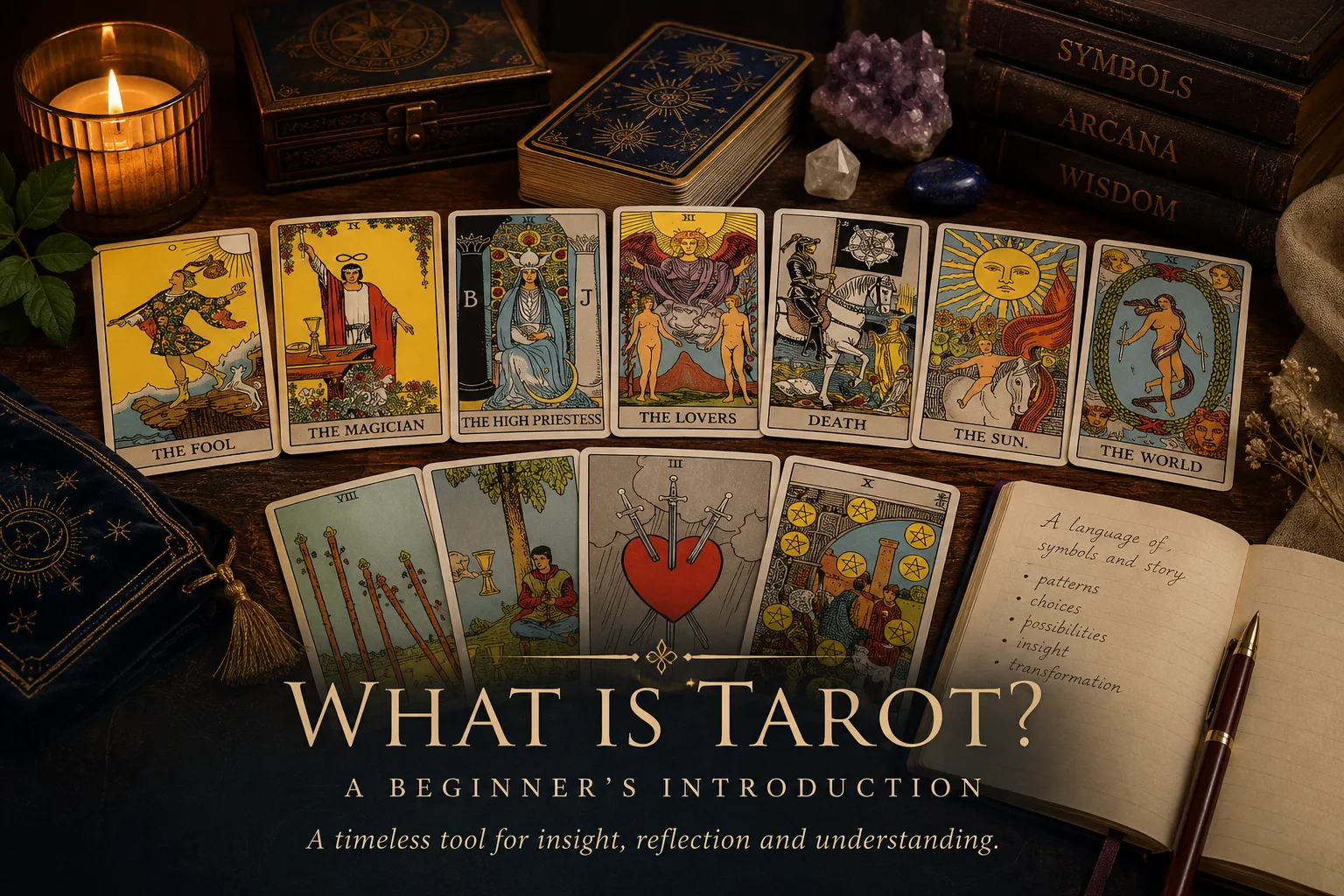
To someone encountering Tarot for the first time, a deck of Tarot cards can seem mysterious. Cards such as The Fool, The Lovers, Death, The Tower, The Sun and The World carry striking images and evocative names, while a Tarot reading often appears to involve an unfamiliar language of symbols, numbers, elements and archetypes.
Yet Tarot becomes much easier to understand once we begin with a simple idea:
Tarot is a structured system of illustrated cards that can be used to explore questions, situations, patterns and possibilities through symbolism and interpretation.
Today, Tarot is most commonly associated with divination, spiritual guidance and personal reflection – but that wasn’t the original idea behind it. The earliest documented Tarot cards emerged in fifteenth-century Italy, where they were used for card games. Their now-familiar association with fortune-telling, occult philosophy and divination developed centuries later.
Understanding this distinction is useful for a beginner because Tarot has never been only one thing. It has changed considerably during its long history, and people continue to approach it in different ways today.
What Does a Tarot Deck Contain?
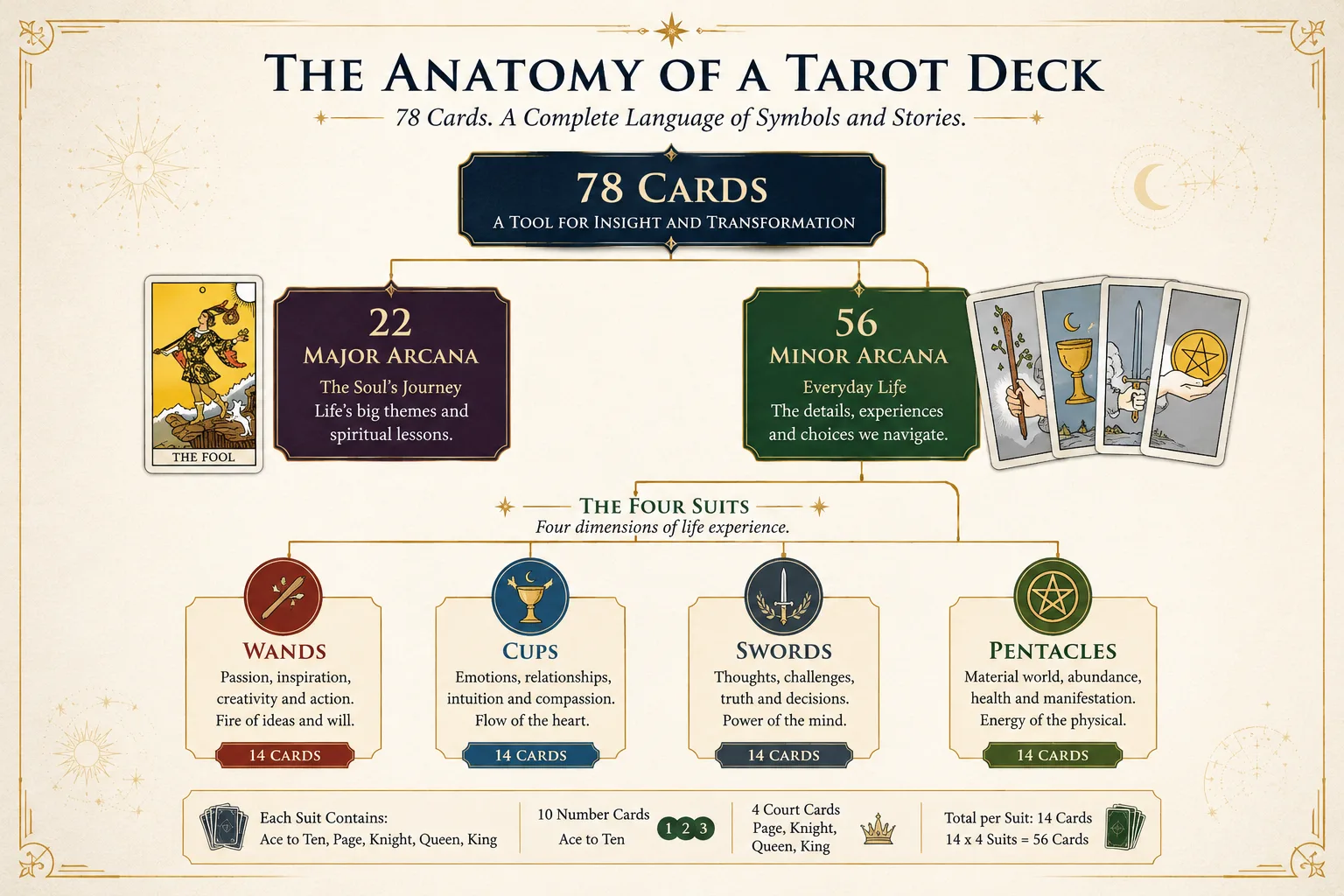
A conventional modern Tarot deck contains 78 cards, divided into two broad groups: the Major Arcana and the Minor Arcana. Historical Tarot packs and modern traditions can vary in naming and arrangement, but this 78-card structure has become standard in many of the decks used for Tarot reading today.
The Major Arcana
The Major Arcana contains 22 cards.
These include some of Tarot’s most recognizable images, such as:
The Fool
The Magician
The Empress
The Lovers
The Hermit
Death
The Tower
The Star
The Sun
In modern Tarot practice, these cards are often interpreted as representing significant experiences, transitions, forces, choices or archetypal themes.
Rather than describing only ordinary events, they often invite the reader to consider the larger meaning or pattern within a situation.
The Minor Arcana
The remaining 56 cards form the Minor Arcana.
They are traditionally divided into four suits. In many modern decks these are:
Wands, Cups, Swords and Pentacles.
Each suit contains numbered cards from Ace to Ten along with four Court Cards. Names can vary between Tarot traditions; for example, Pentacles may be called Coins or Disks, while Wands may also appear as Batons or Staves.
The Minor Arcana is commonly used to explore more immediate aspects of experience—our actions, relationships, thoughts, challenges, resources, emotions and everyday circumstances.
We will explore the Major Arcana, Minor Arcana, suits and Court Cards individually elsewhere in the Library.
How Is Tarot Used?
A Tarot reading usually begins with a question, subject or situation that someone wishes to explore.
One or more cards are then drawn and interpreted. Sometimes the cards are placed in predetermined positions known as a spread, where each position represents a particular aspect of the question. At other times, only one or a few cards may be used.
Interpretation does not come from the image alone.
A reader may consider several layers at once:
the traditional associations of the card,
the imagery appearing on it,
its number,
its suit and element,
the position of the card within the spread,
its relationship with surrounding cards,
the question being explored,
and the particular Tarot tradition or deck being used.
This is why learning Tarot involves considerably more than memorizing seventy-eight definitions.
A card does not necessarily carry one fixed sentence that applies every time it appears.
Its meaning emerges through context and relationship.
Is Tarot About Predicting the Future?
For many people, Tarot is closely associated with fortune-telling, and divination has been an important part of Tarot practice since at least the eighteenth century.
But Tarot is used in several different ways today.
Some practitioners use it primarily for prediction. Others approach it as spiritual guidance. Some use the cards for introspection, meditation, creative exploration or examining a situation from perspectives they may not previously have considered.
These approaches are not necessarily interchangeable, and different Tarot traditions may understand the purpose of a reading quite differently.
For a beginner, therefore, it can be helpful not to begin with the assumption that Tarot must provide an unavoidable description of the future.
A Tarot reading can instead be approached as an interpretive process: a way of considering patterns, possibilities, concerns and choices through a shared, learnable symbolism.
The Language Behind the Cards
Much of Tarot’s richness comes from the fact that its cards communicate through several overlapping symbolic systems.
A single card might contain:
a recognizable human archetype,
a particular number,
an elemental association,
colors,
gestures,
animals,
landscapes,
celestial symbols,
religious or mythological imagery,
and objects carrying their own symbolic associations.
Different Tarot traditions have added further systems of correspondence over time, including astrology, numerology and various forms of Western esoteric philosophy.
Not every deck uses these systems in exactly the same way.
This is one reason it is better to think of Tarot as a language rather than simply a collection of card meanings.
Learning a language means understanding how its parts work together.
The same is true of Tarot.
Does Every Tarot Deck Mean the Same Thing?
Not entirely.
Most traditional Tarot systems share recognizable structures and many recurring cards, but their imagery, names, symbolism and philosophical interpretations can differ quite a bit.
The Tarot de Marseille, Rider–Waite–Smith Tarot and Thoth Tarot, for example, emerged from different historical and interpretive contexts.
Modern artists and Tarot creators have developed thousands of additional decks, often reimagining traditional symbolism through different cultures, philosophies, artistic styles and experiences.
None of this makes interpretation arbitrary – each tradition has built its own substantial body of symbolism over centuries. It does mean that knowing which tradition and deck you’re working with matters, sometimes quite a bit.
We will explore these differences more closely in Different Tarot Traditions and Systems.
Tarot as Symbol and Story
Perhaps one of the easiest ways for a beginner to approach Tarot is to see the cards not as isolated predictions, but as images representing recognizable dimensions of human experience.
Tarot deals in the ordinary shape of a life: beginnings and endings, ambition and hesitation, love found and love lost, conflict and the slow work of making peace.
The Rider-Waite-Smith Ten of Swords is a good example: a figure pierced by ten blades, about as final an image as Tarot offers. Look closer, though, and there’s a sunrise breaking on the horizon behind the figure – traditionally read as a sign that the worst has already happened, and what follows is recovery. That is the kind of thing Tarot is actually doing: taking a recognizable piece of human experience and giving it a picture.
When several cards appear together, they can form relationships and narratives. One image may challenge another. A difficult card may be followed by one suggesting recovery. A card associated with action may appear beside one suggesting reflection or restraint.
A reading, then, is more than the sum of its card definitions – it’s conversation between symbols, each one shifting slightly depending on who else is in the room.
Do You Have to Believe in Tarot?
You do not need to adopt a particular religious or spiritual belief simply to study Tarot.
People approach the cards from very different perspectives.
Someone may understand Tarot spiritually or metaphysically. Another person may value it as a symbolic system for reflection. Another may be interested primarily in its history, art or psychology.
The Library does not require the reader to accept one explanation for why Tarot may feel meaningful.
Instead, our purpose is to understand the system honestly—its history, traditions, symbolism, practices and different ways of interpretation—while allowing the reader to decide how Tarot fits within their own worldview.
Beginning the Journey
Tarot can look complicated at first – seventy-eight cards can feel like seventy-eight things to memorize – but that isn’t really how it works.
As we begin understanding its underlying structure—the Major and Minor Arcana, numbers, suits, elements, archetypes and recurring symbolism, the individual cards gradually stop appearing isolated.
Patterns begin to emerge.
The cards start relating to one another.
What first looked like a collection of mysterious images starts to read like a language with its own grammar – and that’s roughly where learning Tarot actually begins.
This introductory article has only opened the door. From here, we can explore where Tarot came from, how it evolved, why different Tarot traditions developed, how a deck is structured, and eventually how its individual cards communicate meaning.
The objective is not simply to memorize what each card is supposed to say.
It is to learn how to read them – to understand what each card is actually saying, and why.